
As marine and rail terminals embrace digitalization, the limitations of legacy electronic data interchange (EDI) systems can quickly become a difficult operational constraint.
Cargo volumes fluctuate, and many legacy EDI systems can’t scale in response to those changing workloads. Some of these systems were installed by terminals decades ago, and they can struggle to integrate with emerging technologies that can give your operations a competitive edge.
But whether you’re deploying a new EDI solution or attempting to upgrade the system you already have, infrastructure changes are very complex projects. When an EDI transaction fails or a data field doesn’t map correctly, it creates costly disruptions for your operations.
As Tideworks’ Director of EDI Services, I understand the critical role EDI plays in supporting day-to-day terminal operations. I’ve seen firsthand what a difference it makes when you work with trusted EDI managed services experts to upgrade and tailor EDI systems based on your terminal’s unique challenges and needs.
The current state of legacy EDI management systems—and the challenges they yield for terminals
The most pervasive challenges of legacy EDI systems include:
- A lack of standardization: Different carriers, shippers, and customs authorities often use different EDI formats. But your system is expected to integrate with all of them. In-house technical teams often have to do a lot of manual customization just to create one flow.
- High implementation costs: The upfront investment required for EDI systems and their supporting infrastructure can be a significant barrier to adoption.
- Limited IT expertise: Many terminals lack the specialized in-house expertise needed to manage and troubleshoot EDI systems.
- Difficulty operating at scale: Fluctuating cargo volumes and ongoing efforts to increase terminal throughput can push legacy EDI systems beyond their intended workload. This creates bottlenecks and other inefficiencies that disrupt operations and frustrate terminal customers.
- Limited integration with AI and cloud platforms: Many AI and cloud platforms are only built to connect via API, rather than EDI. The rigid, closed architectures of legacy systems can make it difficult or impossible to integrate.
- Cybersecurity risks: As digital systems become more interconnected, the risk of cyber attacks also increases. Even with robust security protocols in place, legacy technology is more prone to vulnerability.
The challenges created by legacy EDI systems are significant. Fortunately for terminals, solutions are available.
There’s a better way to tackle EDI problems
Conventional EDI management isn’t giving terminals what they need. That’s why, at Tideworks, we’ve assembled a dedicated team of EDI experts and full-stack developers with extensive experience in various EDI standards and industries.
Through our full-service model, we take on day-to-day EDI management with an all-inclusive service that includes program management, EDI translation, and visibility tools. This makes EDI management easier and less expensive for your operations.
The benefits of “full service” EDI management
A lot of third-party EDI managed services are focused on providing reactive support: When issues arise, they’ll come in and fix what they can.
But true EDI management is about much more than reactive troubleshooting and issue resolution.
It requires 24/7 monitoring, ongoing maintenance and future-proofing, and setting up connections with new trading partners. It’s about taking care of all the little problems that make your existing EDI system so cumbersome and unsustainable. Those little problems can include the discrepancies between EDI and internal system data, the manual error correction of EDI transactions, and the complexity of handling EDI compliance with different trading partners.
This is exactly the kind of service that Tideworks’ EDI managed services offers our customers. Each member of our EDI team possesses specialized expertise in EDIFACT, X12 standards, and industry-specific messaging formats. We collaborate closely with our clients to tailor-make the EDI message types and connectivity configurations needed when onboarding trading partners, establishing secure data exchanges, and resolving discrepancies between EDI transmissions and internal systems.
When you need to process last-minute changes, we’re here to help. When you need to implement new flows, we have them pre-built and ready to go. And when you need to integrate APIs, we have all of the required infrastructure in place to help you move to a more modern, cloud-based approach.
EDI managed services in action
When Maersk asked SSA Marine MIT to implement new EDI rules for COPRAR messages to manage Inter-Terminal Transport (ITT) movements, the terminal turned to Tideworks’s Professional Services team for help. The ultimate goal of this request was to optimize container positioning for vessels, trains, and trucks, which would allow the operations team to redistribute empty containers based on demand and inventory.
Our EDI experts embraced this request as an opportunity to enhance cargo management and operational efficiency throughout the marine terminal. After analyzing requirements and defining the project’s scope, we achieved seamless integration of these EDI rules without disrupting existing processes.
In the end, our team turned a complex, multi-stakeholder request into smarter solutions and better service for SSA Marine MIT and its shipping partners.
What to look for when evaluating an EDI managed services vendor
As you evaluate your terminal’s options for EDI managed services, here are the key criteria to keep in mind:
EDI standards and formats
The EDI management approach you choose needs to support the standards and formats used in your terminal. Some managed services support a wider range of standards and formats than others.
At Tideworks, for example, we can work with most standards, including EDIFACT, X12 standards, and API-based formats. We also encourage our customers to standardize and document all EDI flows, which will help reduce complexity and improve interoperability.
Real-time visibility and trigger actions
Managed services can dramatically streamline EDI management and eliminate manual data entry and errors, enabling faster and more reliable communication with partners.
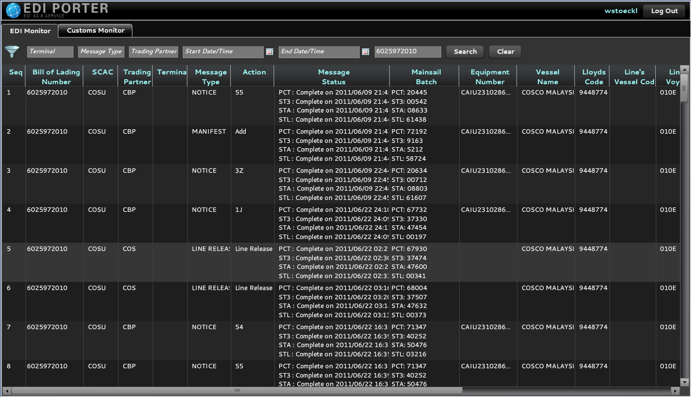
We also use dashboards, alert systems, and analytics to detect failures and potential delays before they happen—which helps operators make proactive decisions and respond quickly.
Systems compatibility
Any EDI service you want to deploy within your terminal must be compatible with your existing terminal operating system (TOS), as well as any other logistic platform standards.
If you’re using Tideworks’ EDI services with our TOS systems, for example, you don’t have to worry about seamless integration. When exchanging EDI messages with shipping lines, a TOS, trading partners, or even the customs manifesting system used by U.S. Customs and Border Protection, you need to conduct your due diligence to make sure these systems are fully compatible.
Partner connectivity
Evaluate each potential EDI service’s ability to reliably and securely connect with and manage all of your existing partners: shipping lines, freight forwarders, customs enforcement, and other stakeholders. These connections play a critical role in supporting efficient terminal operations, and they help maintain strong relationships with your shipping partners.
Scalability and flexibility
Most terminals upgrading their EDI systems are looking to address their limited scalability. But scalability isn’t automatic when choosing an EDI service. Find out if the service you’re considering can handle your current and projected transaction volumes.
At Tideworks, we support more than 40 distinct EDI message types and collaborate with more than185 trading partners. Our system manages more than 2,000 flow combinations across terminals, shipping lines, and message types.
And the scale of our EDI transaction volume continues to grow. After managing more than 16.8 million EDI messages in 2024, our message volume through the first nine months of this year surpassed 44.2 million—proving we can reliably and efficiently support seamless integration at any scale.
Cost
The pricing model of your EDI service will have a significant impact on the long-term ROI of this investment. Depending on your terminal’s size, cargo volume, messaging volume, and future growth plans, you might prefer pricing models that are transaction-based vs. subscription-based.
Figure out whether billing is fixed-price or pay-as-you-go, find out whether a service wants to lock you into a contract, and request an itemized list of fees to make sure you know exactly what you’re paying for.
Focus on running your terminal, not managing EDI
I’ve spent more than 28 years supporting software development, integrations, and operations management for terminals. So I can confidently say that every terminal needs EDI management that can support revenue growth, improve transparency among customers and partners, and increase day-to-day operational efficiency.
But your teams don’t need more work on their plate—especially work that requires specialized knowledge and an expert approach. The solution? EDI management that can support operations, scale terminal throughput, and lay a flexible foundation for continued modernization and growth—all while giving terminal leaders complete control over their day-to-day involvement.
With our dedicated team of EDI experts supporting your terminal, operators can spend less time on manually managing EDI and more time focused on big-picture decisions.
Tideworks’ Professional Services team for EDI is ready to help. Find out how—contact us today to set up a time to talk.